Gauls, Celts, Goths, Teutons, Picts and Scots Greek and Roman
historians reported that Britons, Iberians, Gauls, Goths, Teutons, Picts and
Scots bore tattoo marks.
Greek and Roman
historians reported that Britons, Iberians, Gauls, Goths, Teutons, Picts and
Scots bore tattoo marks.
The Celts were a tribal people who moved across Western Europe between C.1200
and 700 BC. They reached the British Isles around 400 BC and most of what has
survived from their culture is in the areas now known as Ireland, Wales and
Scotland.
|
|
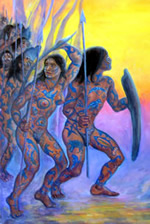
The Celtic culture celebrated body art and permanent body painting was done with
woad, which left a blue design on the skin. Spirals were a common motif and
appeared single, doubled or tripled. Knot work is probably the most recognized
form of Celtic art, with lines forming complex braids which weave across
themselves. Celtic knots symbolize the connections in life and the step or key
patterns, like those found in early labyrinth designs, can be seen both in
simple borders and full complex mazes. Designs are symbolic of the various paths
that life's journey can take. |
In his 1925 book, THE HISTORY OF TATTOOING AND IT'S SIGNIFICANCE, W.D. Hambly
wrote, "It seems clear that the Picts tattooed by puncture and that animals were
the chief subject portrayed. The forms of beast, birds, and fish which the
Cruithnae, or Picts tattooed on their bodies may have been totem marks. Certain
marks on faces of Gualish coins seem to be tattoo marks. Tattooing by puncture
was possibly known among such Gualish tribes as Ambiani, Baiocasses and Caletes.
The markings of Picts is historically important in showing the advances of
tattoo by puncture to an extreme northerly point of Great Britain before the
Christian era."
Picts
The Picts were the tattooed tribal nations of the north of Britain, the area
now known as Scotland. In 600 AD, Isadore of Seville makes reference that the
Picts took their name from the fact that their bodies had designs pricked into
their skin by needles.
The Picts were known to have existed from about 7000BC until about the year
845 AD.
The Romans referred to them in Latin as "Pictii", which translates as "The
Painted Ones". This was in reference to the elaborate tribal tattoos with which
the Picts decorated their entire bodies.
In the third century AD, Herod of Antioch, wrote: "the Britons incise on
their bodies colored pictures of animals, of which they are very proud."
In the seventh century AD, St. Isidore of Seville reported that:
The Scots derive their name in their own language from their painted
bodies, because these are marked with various designs by being pricked with
iron needles with ink on them and the Picts also are thus named because of
the absurd marks produced on their bodies by craftsmen with tiny pinpricks
and juice extracted from local grasses.