|

"Haida
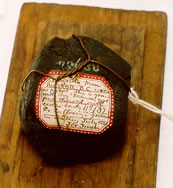
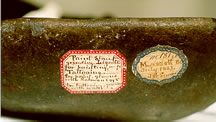
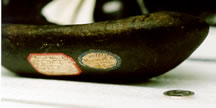
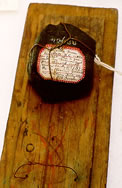
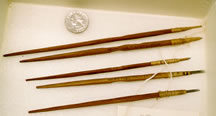
Tattoo Kit" collected by ethnologist James G. Swan - Queen Charlotte Islands, July 1883.
 The
"Haida Tattoo Kit" was uncovered by Lars Krutak at the National Museum of Natural History's Museum Support Center (MSC), where
all objects associated with that museum (which are not on exhibition) are housed.
The search had been initiated after a conversation with Vince Hemingson after Vince
returned from the 2001 Tattoo Tour of the South Pacific in Samoa and New
Zealand. The
"Haida Tattoo Kit" was uncovered by Lars Krutak at the National Museum of Natural History's Museum Support Center (MSC), where
all objects associated with that museum (which are not on exhibition) are housed.
The search had been initiated after a conversation with Vince Hemingson after Vince
returned from the 2001 Tattoo Tour of the South Pacific in Samoa and New
Zealand.
Repatriation research specialist
Between 1999 and 2002, Lars Krutak was a repatriation research specialist with the National Museum of the American Indian, Smithsonian Institution
and is the Technical Consultant for The Vanishing Tattoo television
documentary series. Lars has been published extensively on ethnographic
tattooing among the peoples of the high Arctic.
Astonished to discover...
Vince had visited New Zealand's National Te Papa Museum in Wellington and
was astonished to discover how little was displayed about Maori tattooing.
The Te Papa staff, however, was very interested in The Vanishing Tattoo
project and was eager to assist the Maoris in any way they could to help with
the current tattooing revival going on in New Zealand. A number of Maori ta
moko artists were passionate about reviving the ancient Maori cultural practice
of facial tattooing with chisels, a form of tattooing that is unique
to the Maori.
The War Memorial Museum in Auckland in contrast has quite an extensive
tattooing display, with an excellent collection of artifacts and traditional
tattooing implements from around Polynesia. Similarly, the Samoan National
Museum is also bereft of a display of Samoan tattooing.
 Tremendous excitement... Tremendous excitement...
Lars and Vince surmised that within the Smithsonian's vast collection there
might be tattooing tools that been collected but had subsequently been
overlooked. There was tremendous excitement when Lars discovered what may
well be the only surviving Haida Tattoo Kit and "Bundle" of Tattoo Implements
in the entire world. "When Lars phoned me with the news of his discovery, I
was incredibly excited," says Hemingson.
"In my opinion this is a major archaeological and anthropological find. With
these tools, the Haida of the Pacific Northwest could accurately
re-create a lost cultural tradition, if that was something they were
interested in. The actual implements themselves would reveal a tremendous
amount about how the tattoos were done. Nothing would make us happier than
to be able to assist the Haida in resurrecting the lost tradition of
tattooing "
 I was somewhat
surprised...
I was somewhat
surprised...
"When Lars came to Vancouver and showed me the pictures," Hemingson said, "I
have to admit I was somewhat surprised. I was expecting tattoo implements
similar to the Polynesian designs but instead I found myself looking at
pictures that showed tools very similar to the traditional Japanese
hand-poking instruments."
Even more
exciting...
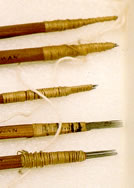
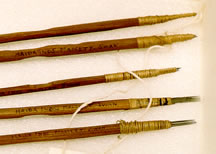
"What was even more exciting," continued Hemingson, "was that Lars said the
paint brushes with the
tattoo kit still had pigment on them and showed that
both black and red pigment had been used.
The Haida, the Mocoví and adjacent
groups of the Gran Chaco region of South America, and a vanished group, the Neutral Indians on Ontario
who used a red pigment
comprised of hematite or plant matter (roots) are, to the best of our
research knowledge to date, the only indigenous people in
the world that
created tribal tattoos using any pigment other than black."
Shed
some fascinating light on this subject...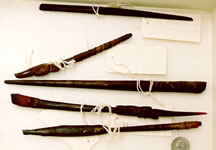
The Vanishing Tattoo documentary series intends to try and find out what the
Haida used for their pigments. A preliminary discussion with Bill McLennan
at UBC's world-renowned Museum of Anthropology has already shed some
fascinating light on this subject. McLennan says that pigment analysis to
date shows that the Haida used magnetite for black pigments and hematite for
red pigments. They also used blue-green paint in their traditional art
work but did not apparently tattoo in those colors. It will be interesting
to see if the black pigment used in tattooing was not lignite (a form of
carbon-based coal) as collected and documented by J. G. Swan in 1883, but
magnetite instead.
The Vanishing Tattoo has spoken with well-known Haida artist Robert Davidson
about the possibility of re-creating the traditional Haida tattoos.
All
pictures of tattoo kit tools or objects may be clicked for larger images and more
information
All tattoo kit images are Copyright © 2002 Lars Krutak All rights
reserved
|
|
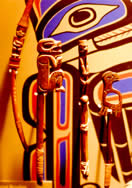
Tools of the Carver's Art - from the Smithsonian Institution
Art permeated every aspect of life in traditional Northwest Coast Indian
cultures -- even the mundane and utilitarian objects of everyday life were
decorated. Traditional carving tools were adzes, chisels, knives, and drills
with blades of sharpened stone, bone, antler, shell or tooth. When trade
with Asian, Europe and the rest of North America became more common, iron and
steel quickly replaced bone and stone.
Though a carver today may use a chain saw to rough in a design and paint the
finished work with enamel house paints, many of the other tools used are not
much changed from these traditional ones collected over 100 years ago.
|
|
Thomas
Lockhart on the Haida Tattooing Instruments
When
first seeing photos of the Haida tattooing instruments, (collected by
ethnologist James G. Swan in 1883) I was struck by the similarity to
Japanese tattooing tools, in particular, the paint brushes. The Japanese
used a stick at least a foot long with needles poking straight out,
firmly attached to the end with thread. The stick would be grasped at
the other end with the right hand, laid across the web of the thumb, and
then using this as a fulcrum, jabbed into the skin. The paint brush
would be held under the middle joint of the left hand, bristles hovering
over the tattoo and offering a fresh supply of pigment for the tattooist
to work from.
 The
sticks the North Coast Indians used appear much shorter than the
Japanese stick though, perhaps
half the length and the needles were in a looser grouping, not flattened
out. I surmise the Haida would have held them in their right hand, much
as we would hold a spoon, and simply pricked the skin repeatedly using
wrist action. I have seen this method used in markets in the South Seas
and Asia. The loose grouping of the needles would explain the extremely
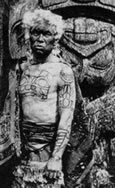
thick lines evident in the Swan photographs from the 1870's. The
sticks the North Coast Indians used appear much shorter than the
Japanese stick though, perhaps
half the length and the needles were in a looser grouping, not flattened
out. I surmise the Haida would have held them in their right hand, much
as we would hold a spoon, and simply pricked the skin repeatedly using
wrist action. I have seen this method used in markets in the South Seas
and Asia. The loose grouping of the needles would explain the extremely
thick lines evident in the Swan photographs from the 1870's.
I had
assumed at first glance they would have used the paint brushes in the
same manner as the Japanese but I remember reading passages in Swan's
writings where the pigment would be drawn on the skin and pricked in
after, followed by more pigment rubbed in. This is where the brushes
would most likely have been used. Now at first this may not sound
feasible, but it certainly would work. If, for instance I tattooed a
small yellow sun on the skin and then tried to tattoo in some blue
background between the rays, simply smearing that blue as I wiped the
tattoo would force enough pigment into the fresh wound to give the
yellow a greenish hue. The particle size of black tends to be relatively
smaller, particularly if it is carbon based, (contemporary blacks are in
the one to three micron range), and would be even easier to force under
the epidermis.
|
|
Lars
Krutak on Haida Tattooing
 Our
knowledge of Haida tattooing kits has been extremely limited until
recently. As part of my many conversations with Vince Hemingson of The
Vanishing Tattoo, I decided to investigate
the possibility that a tattoo kit existed in a museum collection
somewhere: dusty, unused, and lost to time. Luckily, with some
persistence and investigative research, I uncovered at the Smithsonian
what truly seems to represent the last authentic Haida tattoo kit
remaining in the world. It was collected by ethnologist James G. Swan at
Massett, Queen Charlotte Islands, July 1883. Swan authored several Haida
tattoo articles for the U.S. National Museum in the late 19th century,
including the illustrated "Tattoo Marks of the Haida Indians of Queen
Charlotte Islands, B.C., and the Prince of Wales Archipelago, Alaska,"
among others. Our
knowledge of Haida tattooing kits has been extremely limited until
recently. As part of my many conversations with Vince Hemingson of The
Vanishing Tattoo, I decided to investigate
the possibility that a tattoo kit existed in a museum collection
somewhere: dusty, unused, and lost to time. Luckily, with some
persistence and investigative research, I uncovered at the Smithsonian
what truly seems to represent the last authentic Haida tattoo kit
remaining in the world. It was collected by ethnologist James G. Swan at
Massett, Queen Charlotte Islands, July 1883. Swan authored several Haida
tattoo articles for the U.S. National Museum in the late 19th century,
including the illustrated "Tattoo Marks of the Haida Indians of Queen
Charlotte Islands, B.C., and the Prince of Wales Archipelago, Alaska,"
among others.
 Haida
tattooing seemed to be quite rare by 1885. Traditionally, it was
performed in conjunction with the potlatch commemorating the completion
of a cedar-plank dwelling and its frontal pole. Potlatches entailed the
distribution of personal property by the host (house chief) to those who
had performed important functions in the actual construction of the
house. Each gift elevated the status of the house chief and his family
and especially benefited the house owner's children. After the lengthy
exchange of goods, each child of the house chief received a new potlatch
name and costly tattoo that accorded them high-ranking status. One of the last Haida
potlatches that featured tattooing occurred in the
winter of 1900-01 in the village of Skidegate. It was
witnessed and described by anthropologist John R.
Swanton as follows: "[On the second day] they called
them to put the tattoo-marks on. At once they painted
their faces. Those in the house shouted to the people
to come in and look on. When the spectators were all
in, they began dancing, and sang property-songs. Those
who were to be tattooed began dancing. The wife [of
the house chief] stood at the end of the line, wearing
a painted hat. When they had sung four songs, they put
eagle-feathers on the dancers [for purification]. The
house was filled with eagle-feathers. Then they
stopped. Those who put the feathers on them were given
cloth. When that was over, they had those who were to
be tattooed sit down in front of the chiefs. Sometimes
two took a fancy to be tattooed by the same [artist].
Now they beat the ground with a baton, mentioned the
chief's name, and said, 'So and so sits in front of
you to be tattooed.' Then they began to put on the tattoo-marks... All that day they spent in tattooing,
and finished it... The nose, lower lip, and ears were
also pierced by members of the opposite clan. They
were paid a blanket apiece for it."
Tattoos
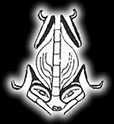
depicted the crests of the family and included, for example: land
animals (Bear, Wolf, Beaver); sea animals (Killer Whale, Halibut, Shark); birds
(Eagle, Hawk, Thunderbird, Owl) as well as geographical features
(Mountain, Iceberg); celestial bodies (Sun, Stars, Moon) and natural
materials (Copper, Clay, Yellow Cedar). Haida
tattooing seemed to be quite rare by 1885. Traditionally, it was
performed in conjunction with the potlatch commemorating the completion
of a cedar-plank dwelling and its frontal pole. Potlatches entailed the
distribution of personal property by the host (house chief) to those who
had performed important functions in the actual construction of the
house. Each gift elevated the status of the house chief and his family
and especially benefited the house owner's children. After the lengthy
exchange of goods, each child of the house chief received a new potlatch
name and costly tattoo that accorded them high-ranking status. One of the last Haida
potlatches that featured tattooing occurred in the
winter of 1900-01 in the village of Skidegate. It was
witnessed and described by anthropologist John R.
Swanton as follows: "[On the second day] they called
them to put the tattoo-marks on. At once they painted
their faces. Those in the house shouted to the people
to come in and look on. When the spectators were all
in, they began dancing, and sang property-songs. Those
who were to be tattooed began dancing. The wife [of
the house chief] stood at the end of the line, wearing
a painted hat. When they had sung four songs, they put
eagle-feathers on the dancers [for purification]. The
house was filled with eagle-feathers. Then they
stopped. Those who put the feathers on them were given
cloth. When that was over, they had those who were to
be tattooed sit down in front of the chiefs. Sometimes
two took a fancy to be tattooed by the same [artist].
Now they beat the ground with a baton, mentioned the
chief's name, and said, 'So and so sits in front of
you to be tattooed.' Then they began to put on the tattoo-marks... All that day they spent in tattooing,
and finished it... The nose, lower lip, and ears were
also pierced by members of the opposite clan. They
were paid a blanket apiece for it."
Tattoos
depicted the crests of the family and included, for example: land
animals (Bear, Wolf, Beaver); sea animals (Killer Whale, Halibut, Shark); birds
(Eagle, Hawk, Thunderbird, Owl) as well as geographical features
(Mountain, Iceberg); celestial bodies (Sun, Stars, Moon) and natural
materials (Copper, Clay, Yellow Cedar).
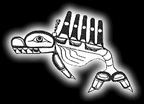 The
possession of crests by a family, clan, or house derived from events
that the Haida recount in their oral traditions, events that account for
their unique identity as a group. Crests explain Haida existence in this
world: linking them to creatures or objects in the natural environment
and to other clans. Crests also chronicle the origin of supernatural and
significant events in the history of the clan. They serve as title to
the object on which they are placed and to the site and geographical
region where these events occurred. Crests symbolize these special
relationships and embody the spirit and being of and in themselves.
Thus, the crest, and the right to use it in stories or in tattoo ritual,
set the particular group and/or individual apart from other Haida groups
while defining their position with The
possession of crests by a family, clan, or house derived from events
that the Haida recount in their oral traditions, events that account for
their unique identity as a group. Crests explain Haida existence in this
world: linking them to creatures or objects in the natural environment
and to other clans. Crests also chronicle the origin of supernatural and
significant events in the history of the clan. They serve as title to
the object on which they are placed and to the site and geographical
region where these events occurred. Crests symbolize these special
relationships and embody the spirit and being of and in themselves.
Thus, the crest, and the right to use it in stories or in tattoo ritual,
set the particular group and/or individual apart from other Haida groups
while defining their position with 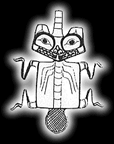 respect to each. Therefore, the right
to a crest, the right to use the emblem, was more valuable than any
object, or human body, that represented it. respect to each. Therefore, the right
to a crest, the right to use the emblem, was more valuable than any
object, or human body, that represented it.
Traditional
Haida tattoos (ki-da) covered the arms, chests, thighs, upper arms, feet, and
sometimes an individual's back. A typical kit consisted of a stone
dish to mix magnetite (black) and hematite (red) pigments, cedar brushes
with crests carved into each handle, and 4 or 5 cedar batons with
various configurations of needles depending on the desired effect:
shading, outlining, fill, etc. Thomas Lockhart of The Vanishing Tattoo
and West Coast Tattoo in Vancouver recently demonstrated that the Haida
kit closely resembles that of the Japanese hand-poker.
Although
Haida tattooing practices are all but dead, the recent resurgence in
traditional Haida arts may well foster and provide new life for the
ancient custom. With the assistance of renowned Haida carver Robert
Davidson and Vince Hemingson of The Vanishing Tattoo, it is our hope to
complete the formal arrangements for a temporary loan of the kit from
the Smithsonian's National Museum of Natural History to the Haida
people themselves. Duplicates could be made and later utilized by
interested artists. This effort would offer a permanent and lasting
solution to the common legacy and historical roots of Haida communities
separated by decades of artificial isolation from their indelible past.
** Excerpted from an article by Lars Krutak entitled:
"Rediscovered! An Early Haida Tattoo Kit from the Queen Charlotte Islands."
Pp. 11-13 in Skin & Ink: The Tattoo Magazine. November 2002.
top
of page |