South American Tattooing
(Peru)
11th Century
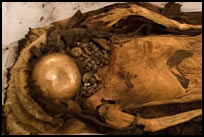
In 1920, archaeologists in Peru unearthed tattooed mummies dating from the
11th Century AD. Not much is known about the significance of tattooing within
the culture of pre-Incan peoples like the Chimú who tattooed, but the elaborate nature of the designs
suggests that tattooing underwent a long period of development during the
pre-Inca period.
|
|
According to Lars Krutak (Cultural Anthropologist and
our Technical Advisor): "The Chimú of Pre-Columbian Peru applied tattoo pigments with various types of needles (fishbone, parrot quill, spiny conch) which have been found in mummy burials. The technical application of tattooing was a form of skin-stitching, and it has been suggested that women were the primary tattoo artists. |
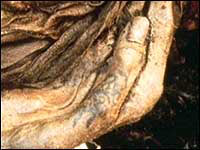 Paleopathological studies of Chimú mummies (1100-1470 A.D.) indicate that the practice of tattooing was quite common among both males and females. In some coastal settlements, it has been estimated that at least thirty percent of the population may have been tattooed."
Later, during the Incan period, nobility NEVER tattooed because it was believed that
the Sun God already gave them perfect bodies.
(Gran Chaco)
18th Century
According to Lars Krutak: The
Gran Chaco is a vast arid plain located at the center of the South American continent.
Tattooing in the Chaco has been largely replaced by less painful and infective
forms of body-painting in the modern-era, it had "magical" implications in the
past and nearly all indigenous groups practiced it.
In 1750, the Jesuit missionary Martin
Dobrizhoffer provided a rare account of the
actual ritual among the now-extinct Abipón.
His observations are said to have been typical of all Chaco groups that
practiced tattooing in the past.
Tattoo Museum Bibliography, Resources and Links
 See all South American Tattoo Culture Articles here
Additional Resources
Mummy of Tattooed Woman Discovered in Peru Pyramid - An exquisitely
preserved and elaborately tattooed mummy of a young woman has been
discovered deep inside a mud-brick pyramid in northern Peru,
archaeologists from Peru and the U.S. announced. (See
photos of the mummy from National Geographic magazine.)
Tattooed mummy, baptized the Lady of Cao, discovered in Peru
May 16, 2006. Source: MSN News, AP, National
Geographic
Tattooed mummy puzzles scientists in Peru. They say items found
alongside female hint that she was a warrior...
See the Lars Krutak articles; Tattooed Tribes of the Amazon, The Mundurucú: Tattooed Warriors of the Amazon Jungle and Tattooing in the Gran Chaco of South America for more
information about tattoos & tattooing in South America.
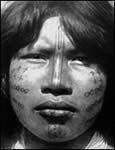
Historically, all Amazonian tribes were identified by unique
facial tattoos.
The Matsés have accentuated lines tattooed on their faces to
identify them as members of their tribe. The
Movement in the
Amazon for Tribal Subsistence and Economic Sustainability (MATSES)
is an organization of the Matsés tribe offering assistance to the
Matsés people.
Amazon
Indians Native Tribe Photos | Videos - Introduction to
Amazon native tribes of the Rainforest. Source for photos and videos
of Amazon Indian tribes and indigenous people of the Amazon,
including photo gallery and images.